
RoboTwin · Clean
t=0Overview
Abstract
Geometric structure provides a direct description of the 3D world and is essential for robotic manipulation and world understanding. Most VLA models primarily rely on 2D representations of the current observation, while geometry-aware approaches often require additional 3D geometric information. However, such geometric information, typically inferred independently from individual observations, is often discarded rather than accumulated into a persistent task representation. Our key insight is that action generation needs a compact, task-relevant geometric abstraction that can be continuously updated over time, rather than a complete, renderable 3D reconstruction at every step. Based on this insight, we introduce GeoMem-VLA, a VLA framework that internalizes explicit 3D supervision into dedicated geometric tokens, without directly aligning the VLM’s native visual embeddings to the teacher feature space, and maintains them as temporal memory for action generation. During training, a frozen geometry foundation model supervises learnable GeoPlan tokens through a geometric flow-matching objective over the current scene point map and future end-effector tracks. These tokens are subsequently integrated with the memory of observation representations, where historical information is retrieved, adaptively fused with current observations, and consolidated to keep event frames as the task progresses. At inference, the policy retrieves historical representations and fuses them with the current working representation to predict actions, without invoking the 3D teacher or explicitly reconstructing the scene. After benchmark-specific downstream adaptation, GeoMem-VLA achieves 98.9% average success on LIBERO and 91.10% / 91.24% on the clean/randomized settings of the RoboTwin benchmark. In 5 real-world tasks, GeoMem-VLA achieves 78.0% average success. These results indicate that internalizing and remembering 3D scene understanding is a promising approach to optimizing robot control strategies.
Model Architecture
GeoPlan Tokens
Learnable GeoPlan tokens are appended to the vision–language sequence. Their hidden states are projected into a compact geometry representation, while the VLM’s native observation embeddings are preserved for action generation.
3D Supervision
A frozen VGGT teacher provides current-scene point maps. The 3D spatial plan head jointly predicts scene geometry and future end-effector tracks through geometric flow matching. This auxiliary supervision trains the GeoPlan representation.
Temporal Memory
Separate memory banks retain observation and geometry representations. Current tokens retrieve historical context through cross-attention, and an adaptive gate fuses the retrieved features. Similar adjacent entries are consolidated to maintain a bounded memory.
Action Expert
A conditional diffusion transformer generates action chunks with flow matching from the current representation and retrieved memory. At inference, the policy uses latent geometry and temporal context without running VGGT or explicitly reconstructing the scene.
3D Reconstruction
Training-time geometric supervision
GeoPlan tokens learn a compact, task-relevant 3D description from a frozen VGGT teacher. These four RoboTwin simulation cases compare the 256-point teacher target, the student reconstruction, and the point-wise error across three views.
RoboTwin · Randomized
t=126Stack three blocks
RoboTwin · Randomized
t=0Open microwave (random)
RoboTwin · Randomized
t=0Open laptop
All examples in this section are RoboTwin simulation cases. The point-wise error is shown in normalized point-map units; the frozen teacher is used only for training supervision.
EEF Track Prediction
Future end-effector waypoints
The same geometric head predicts a 50-step future track for each arm. Reference paths are dashed and model predictions are solid. The right-hand plot reports per-waypoint 3D error in centimetres.
EEF tracks are an auxiliary training target. The panels report saved model outputs on the same four RoboTwin simulation cases shown in 3D Reconstruction.
Memory Bank & Event Frames
Causal retrieval and event consolidation
Observation and geometric banks read earlier frames, then consolidate similar neighbours when the memory is full. The supplied panels show RGB frames, Obs. Mem, Geo. Mem, shaded shared bands, and enlarged event frames selected by the intersection of both banks.
RoboTwin · Clean simulation
Open microwave (clean)
Shared shaded bands mark frames retained by both memory banks; the corresponding event frames are enlarged below.
RoboTwin · Randomized simulation
Stack three blocks
Shared shaded bands mark frames retained by both memory banks; the corresponding event frames are enlarged below.
RoboTwin · Randomized simulation
Open microwave (random)
Shared shaded bands mark frames retained by both memory banks; the corresponding event frames are enlarged below.
RoboTwin · Randomized simulation
Open laptop
Shared shaded bands mark frames retained by both memory banks; the corresponding event frames are enlarged below.
Simulation cases only. All three analysis modules use the same four tasks in the same order.
Experiment Results
Success rate (%). Published baselines may use different training data and evaluation protocols.
Real-World Experiments
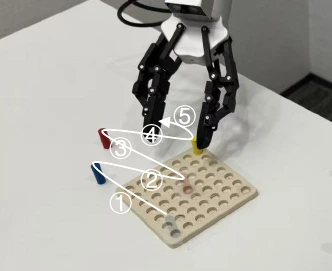
Pick and Stand Sticks
Astribot S1 · 90% success · Task setup
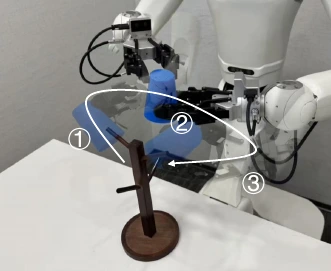
Transfer Cup Across Rack
Astribot S1 · 70% success · Task setup
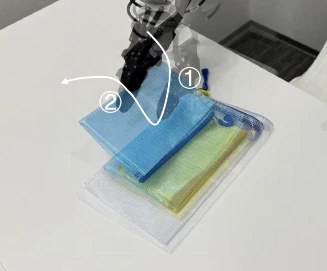
Separate File Pockets
Astribot S1 · 100% success · Task setup
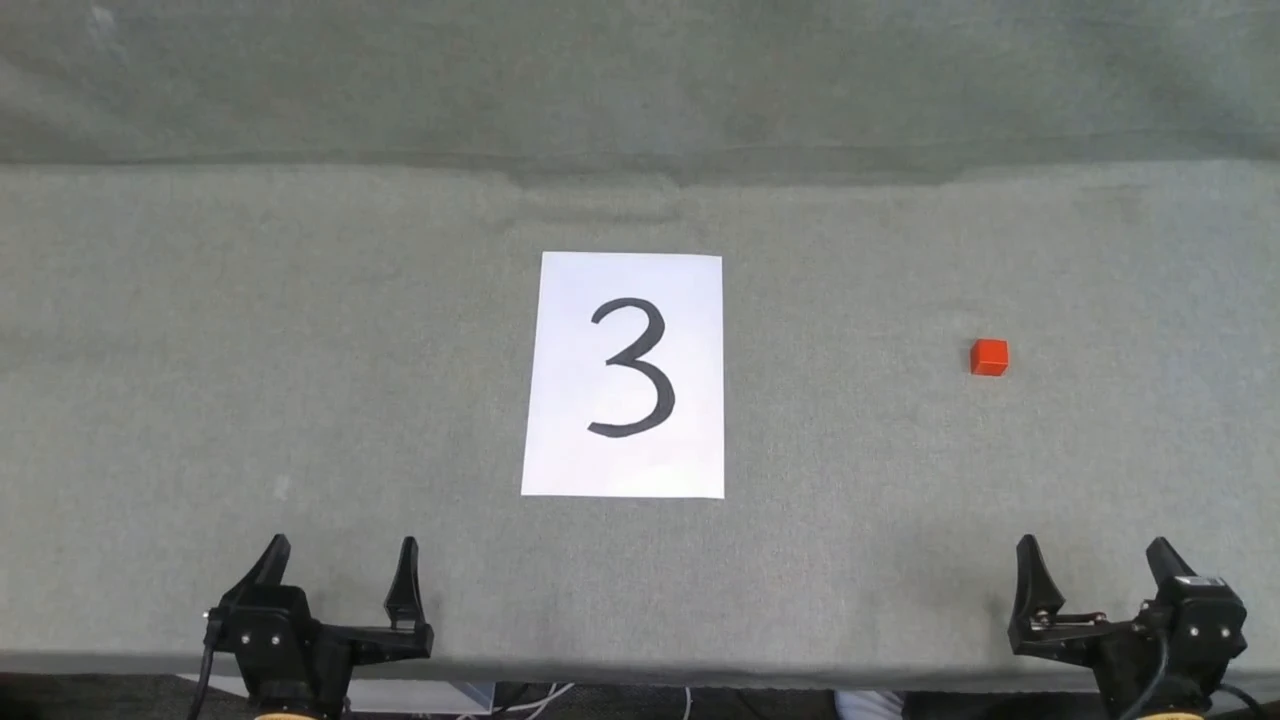
Pick Cube n Times (n = 3)
AgileX Cobot Magic 2 · 50% success · Task setup
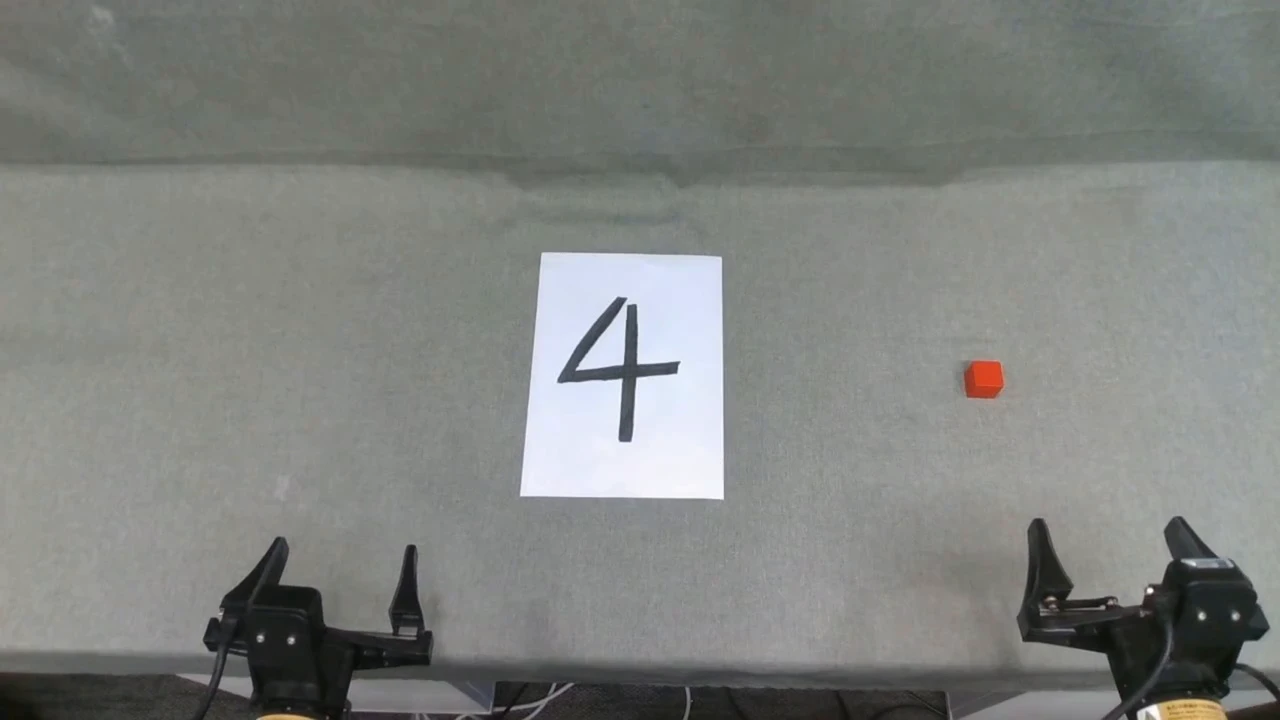
Pick Cube n Times (n = 4)
AgileX Cobot Magic 2 · Video
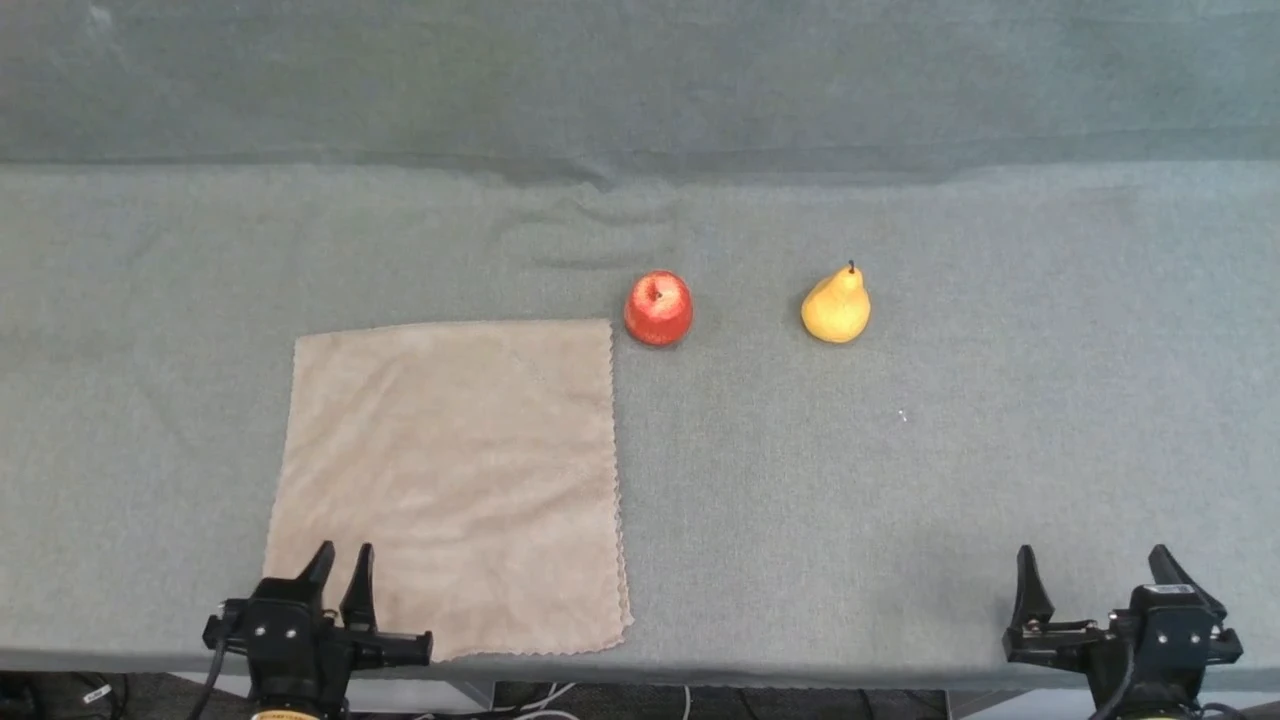
Cover and Find the Apple
AgileX Cobot Magic 2 · 80% success · Task setup
10 rollouts per task.
Citation
BibTeX coming soon.